Every few weeks the internet picks two AI tools and demands you declare a winner. This month it’s OpenClaw vs Claude Code. Here’s the thing nobody wants to hear: it’s almost the wrong question — because these two aren’t really competing for the same job. Let’s untangle it.
The 10-second answer
- OpenClaw = a personal assistant for your whole life. It handles your messages, calendar, files, even your smart lights.
- Claude Code = a specialist for one thing: writing and fixing code. It lives in your developer tools and stays there.
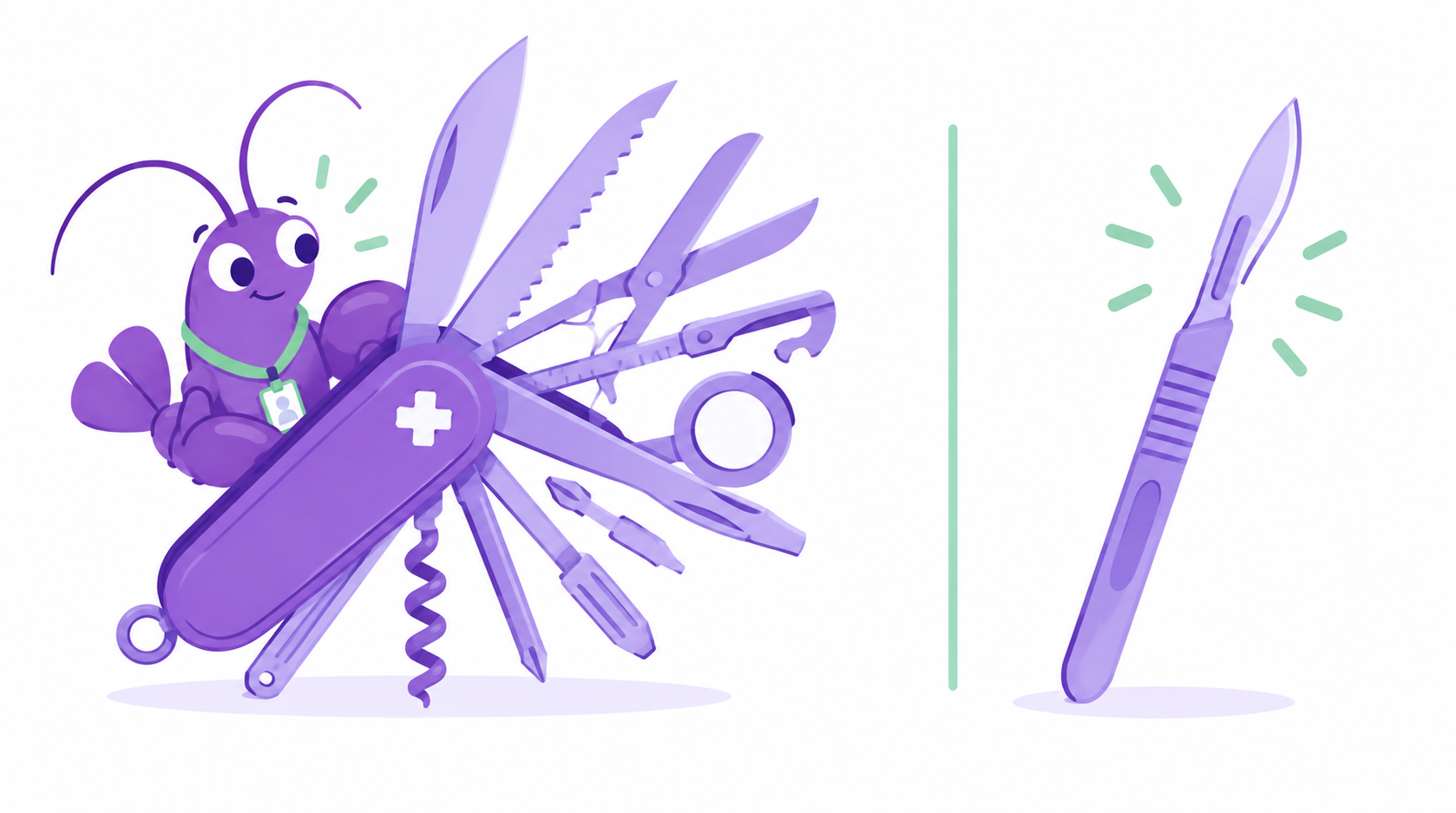
Asking which is “better” is like asking whether a Swiss Army knife beats a scalpel. Depends entirely on whether you’re opening a package or performing surgery.
What each one is really for
| OpenClaw | Claude Code | |
|---|---|---|
| Built to | Run your digital life | Write & fix software |
| Lives in | Your messaging apps, your machine | Your code editor / terminal |
| Made by | A non-profit foundation, open-source | Anthropic (the Claude company), proprietary |
| Costs | Free app + you pay for the AI brain | Paid product / subscription |
| Best for | Tinkerers automating everyday stuff | Developers writing code |
Plot twist that dissolves half the drama: OpenClaw doesn’t even have its own AI. It borrows a “brain,” and that brain can literally be Claude. So this was never really Anthropic vs. the open-source world to begin with.
The difference that actually matters: the leash
This is the part most comparison posts skip, and it’s the most important one.
Remember our eager intern from What Is OpenClaw? →? Claude Code is the intern who’s only allowed into one room. OpenClaw is the intern holding the master key to the whole building.
Claude Code is kept on a short leash on purpose. It works inside a sandbox (a walled-off space) and asks for explicit permission before it does anything risky. Anthropic runs a dedicated security team behind it. It touches your code, but it can’t casually wander into the rest of your machine.
OpenClaw runs off the leash by design. That’s the whole appeal — it can reach your email, files, and apps, because that’s what makes it useful as a life assistant. But as we covered in Is OpenClaw Safe? →, that freedom is also exactly why it’s had real security trouble.
So it’s not “one is good, one is bad.” It’s: one is a specialist with guardrails, the other is a generalist without many. Different tools, different risk levels, different jobs.
Which should you pick?
Forget the hype and answer one question — what are you actually trying to do?
- “I want to write code faster.” → Claude Code. Full stop. It’s purpose-built, it asks before it acts, and it’s the safer, saner choice for that job.
- “I want AI to run errands across my apps and I love tinkering.” → OpenClaw — but only if you’ll set it up carefully (see the safety guide).
- “I just want help with emails, writing, and everyday questions.” → Honestly? Neither. A normal chatbot like ChatGPT or Claude in your browser does that with zero setup and zero risk.
The bottom line
OpenClaw and Claude Code aren’t rivals. They’re a generalist and a specialist that happened to trend the same week. The scalpel stays in the operating room and does its one job beautifully; the Swiss Army knife is genuinely handy but needs watching. Pick by the job, not by the headline. Coder? Claude Code. Life-automator with a taste for tinkering? OpenClaw, carefully. Everyone else? The chatbot you already have is probably the right answer, and nobody’s putting that on a hype thread.
Still fuzzy on what OpenClaw even is? Start here: What Is OpenClaw? →