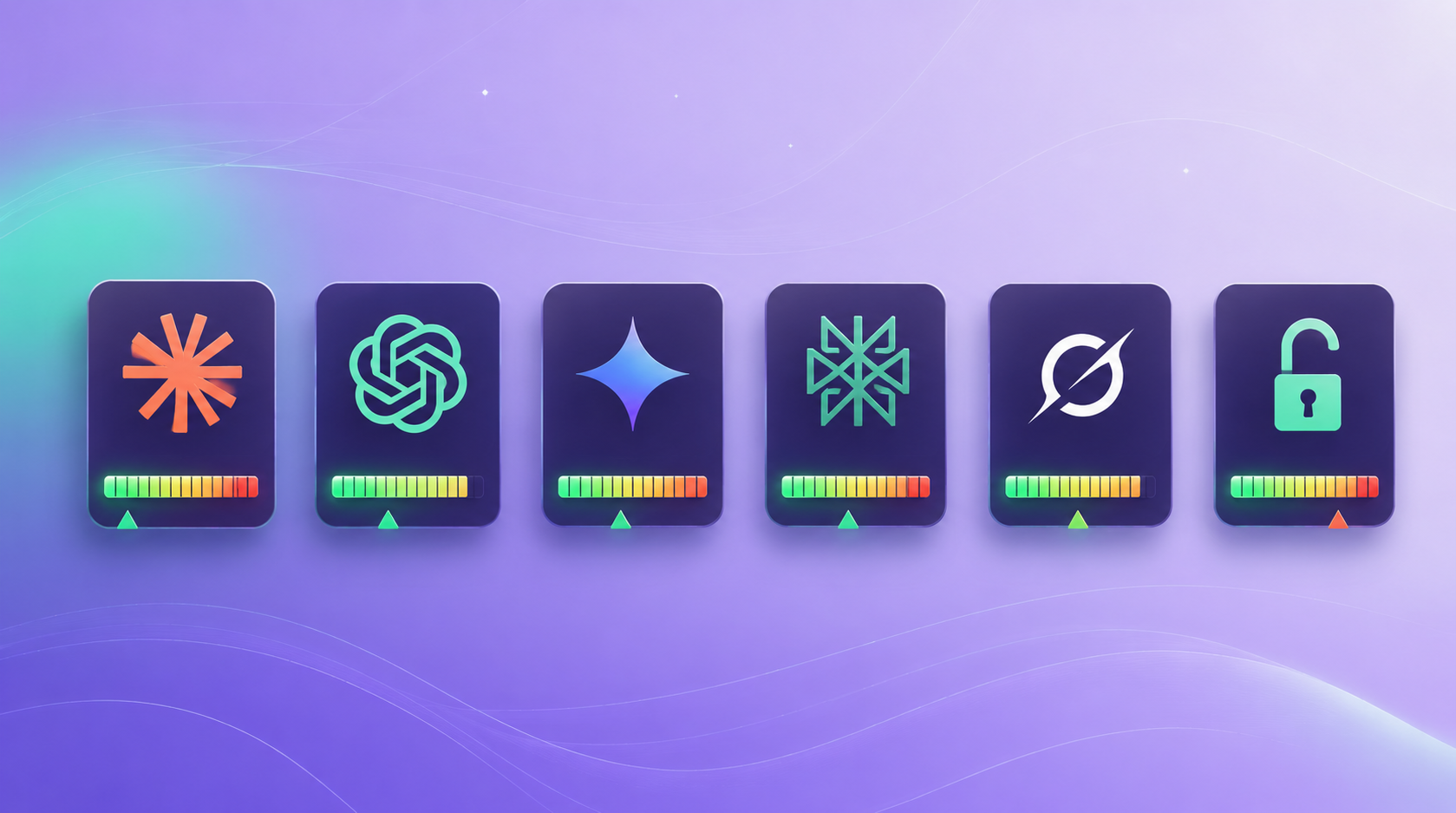
You just got an answer from ChatGPT that sounds perfect. But would Claude have said the same thing? Would Gemini agree? Or would they all give you three completely different “facts”?
Not all AI models hallucinate equally. Some are more careful. Some are more confident. Some just make stuff up more often than others. Here is what the actual benchmarks say — no hype, no Silicon Valley PR speak.
The independent Vectara HHEM leaderboard measures how often a model invents facts when summarizing — tested on 7,700+ real documents across news, science, medicine, law and business. The lowest hallucination rates right now:
| Model | Hallucination rate |
|---|---|
| finix_s1_32b (Ant Group) | 1.8% |
| GPT-5.4 nano (OpenAI) | 3.1% |
| Gemini 2.5 Flash-Lite (Google) | 3.3% |
| Phi-4 (Microsoft) | 3.7% |
| Llama 3.3 70B (Meta) | 4.1% |
| Mistral Large (Mistral) | 4.5% |
| Qwen3-8B (Alibaba) | 4.8% |
The short answer: among the big-name providers, OpenAI’s GPT-5.4 and Google’s Gemini 2.5 currently lead this summarization benchmark, with open-source models like Llama and Qwen right behind. One catch: this score only measures summaries. Claude’s real strength — admitting when it does not know — is not captured by this single number (more on that below). Source: Vectara HHEM-2.3 leaderboard.
Why There Is No Single “Hallucination Score”
This is the most important thing to understand before we look at any numbers: a model can be extremely reliable at math but completely unreliable at citing sources. Or vice versa.
That is why serious benchmarks do not just measure “hallucinates yes/no.” They test different types of tasks:
- Summaries — does the AI invent details not in the original text?
- Factual knowledge — are numbers, dates, and names correct?
- Unanswerable questions — does the AI admit when it does not know?
- Medical questions — how dangerous are the errors?
- Long documents — does information get lost or changed?
- Sources and citations — do the referenced studies actually exist?
So “which AI is most reliable” depends entirely on what you are asking it to do.
The Big 4 Compared
Claude (Anthropic) — The Careful One
Claude models consistently stand out for one thing: they are more likely to say “I am not sure” instead of guessing.
Where it shines:
- Lower hallucination rates in summaries
- More honest about uncertainty
- Strong in medical contexts (according to MedRxiv studies)
- Less “overconfidence” — fewer self-assured wrong answers
Where it struggles:
- Can be too cautious — sometimes refuses answers it could actually give
- Less “bold” in creative tasks
Best for: Research, fact-checking, medical questions, anything where accuracy beats creativity.
ChatGPT / GPT-5 / o-Models (OpenAI) — The All-Rounder
OpenAI now offers different model types: GPT-5 for general tasks and the o-models for complex reasoning.
Where it shines:
- GPT-5 hallucinates significantly less than GPT-4o — measurably so
- The o-models are particularly strong at logic and multi-step thinking
- Excellent language quality and structure
- Strong coding abilities
Where it struggles:
- OpenAI researchers themselves admit: training methods tend to motivate guessing over honest “I do not know” responses
- Still prone to inventing sources and citations
Best for: Logic tasks, programming, structured writing, everyday tasks.
Gemini (Google) — The Multitasker
Google Gemini hits top scores in many benchmarks, especially for multimodal tasks (text + image + code).
Where it shines:
- Extremely strong at multimodal tasks
- Good at math
- Huge context window — can process very long documents
- Live web access reduces hallucinations about current events
Where it struggles:
- Tendency toward “overconfidence” — answers questions wrong rather than admitting uncertainty
- Performance varies significantly by task type
Best for: Image analysis, long documents, multimodal tasks, current research with web search.
Grok (xAI) — The Risky One
Grok positions itself as the less filtered model. That has consequences for reliability.
Where it shines:
- Fewer content restrictions
- Integrated into X (Twitter)
Where it struggles:
- Higher hallucination rates than competitors in benchmark tests
- Less research transparency
- Quality varies between versions
Best for: Unfiltered conversation, social media context. For fact-based work, not your first choice.
The Side-by-Side Comparison
| Task Type | Claude | ChatGPT | Gemini | Grok |
|---|---|---|---|---|
| Admitting uncertainty | Strong | Medium | Weak | Weak |
| Facts & summaries | Strong | Strong | Strong | Medium |
| Logic & reasoning | Strong | Very strong | Strong | Medium |
| Medical questions | Very strong | Strong | Medium | Weak |
| Long documents | Medium | Medium | Strong | Medium |
| Sources & citations | Medium | Medium | Medium | Weak |
How to read this: Green = reliable in benchmarks, Amber = decent but with gaps, Red = be extra careful here.
What the Numbers Actually Say
Short summaries: under 5% hallucination rate for the leaders. As the leaderboard above shows, the top models only invent details in roughly 2 to 5 percent of short summaries. Sounds good — but if you do 100 summaries a day, that is still up to 5 invented facts.
Unanswerable questions: 50-90% failure rate. When models get deliberately trick questions, many still produce an answer 50 to 90 percent of the time — instead of honestly saying “I do not know.” Claude tends to do better here because it is more willing to decline.
Medical questions: 20-80% depending on the task. Simple diagnosis questions work OK. Lab data interpretation and chronological reasoning? Hallucination rates skyrocket to 80 percent and beyond.
Long documents: Silent errors. Microsoft researchers found that current AI models introduce “substantial errors” when editing long documents. Information gets lost, details change — and the model does not mention it.
The Golden Rule: Cross-Check What Matters
The honest answer to “which AI hallucinates the least?” is: it depends on what you are asking.
That is why the best strategy is not finding the perfect model — it is using multiple models to check each other.
1. Ask your question in ChatGPT
2. Ask the same question in Claude
3. Ask the same question in Gemini
If all three agree: probably correct.
If they disagree: take the most plausible parts from each and Google the specific point that differs.
Two minutes. That is all it takes to be smarter than 95% of AI users.
And here is the thing: you do not need to do this for every single AI interaction. Writing emails, brainstorming ideas, rephrasing text — just use one tool and go. The cross-check is only for moments when you are taking AI answers as facts that will affect real decisions. Health, legal, financial, scientific stuff. That is it.
No fear. Just common sense when it counts.
Related Articles on DumbItDownAI
- AI Slop: Why 90% of AI Content Is Garbage (And How to Not Add to the Pile)
- AI Hallucinations: Why Your AI Sometimes Makes Stuff Up
- AI Safety 101: Protect Your Privacy
- ChatGPT vs Claude vs Gemini: Which Free AI?
- How to Write AI Prompts That Actually Work
Want to create AI explainer videos without a camera? Fliki turns your text into professional videos — perfect for breaking down complex topics like this one.
The Bottom Line
No model is hallucination-proof. But there are clear differences: on the current Vectara benchmark, GPT-5.4 and Gemini 2.5 post the lowest summary hallucination rates; Claude is the most cautious about admitting uncertainty, ChatGPT is strongest at logic, Gemini handles long documents and multimodal tasks best, Grok is the riskiest.
But honestly, the most important takeaway from all these benchmarks is not which model wins — it is that you should never rely on just one AI for anything that actually matters. Two minutes with a second model can save you hours of trouble.
Use AI. Love AI. Just double-check the important stuff. That is the whole secret.
Frequently Asked Questions
Which AI hallucinates the least in 2026?
On the independent Vectara HHEM-2.3 leaderboard (updated August 2026), the lowest summary hallucination rates among well-known providers are OpenAI’s GPT-5.4 nano (3.1%) and Google’s Gemini 2.5 Flash-Lite (3.3%). The open-source model finix_s1_32b scores lowest overall at 1.8%. This benchmark measures factual accuracy in summaries only.
Is ChatGPT or Claude more accurate?
It depends on the task. ChatGPT (GPT-5) scores marginally lower on the summary hallucination benchmark, while Claude is the most likely to admit uncertainty instead of guessing — which makes it more reliable for research, medical and fact-checking questions where a confident wrong answer is dangerous.
Which AI is best for fact-checking?
Claude, because it more often says “I’m not sure” instead of inventing an answer. For anything critical, the safest method is to cross-check the same question across ChatGPT, Claude and Gemini: if all three agree it is probably correct; if they disagree, verify the specific point that differs.
Does Gemini hallucinate more than ChatGPT?
On summaries the two are close, with GPT-5.4 slightly ahead. Gemini’s weakness is overconfidence — it tends to answer uncertain questions rather than admit it does not know — but its live web access and large context window make it strong for current events and long documents.
How do I stop AI from making things up?
You cannot fully stop it — no model is hallucination-proof. The practical fix is the 2-minute cross-check: ask the same question in two or three different AI models and only trust the parts they agree on. Reserve this for facts that affect real decisions (health, legal, financial, scientific).