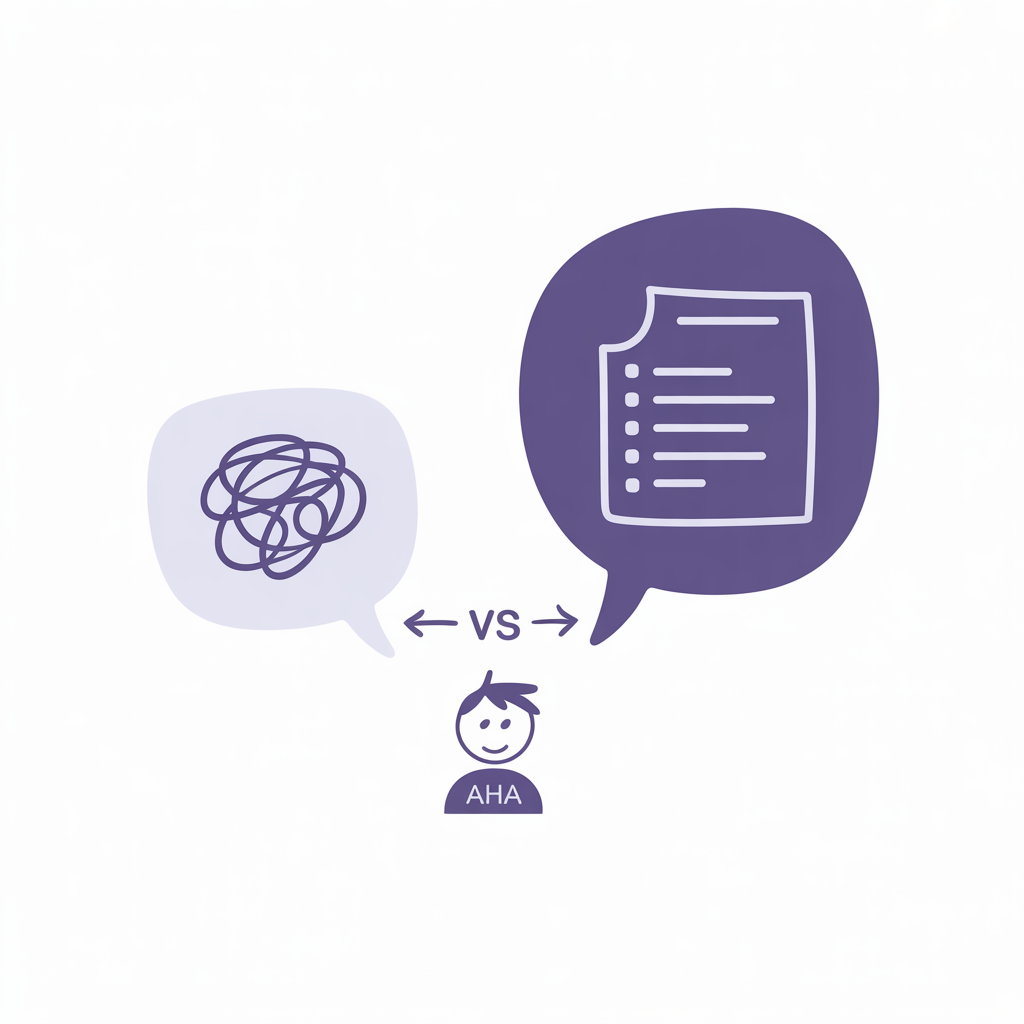
The difference between a good AI response and a useless one is usually the prompt. And no, "write me something good" is not a prompt. That is a prayer. Learning to write good prompts is the single most valuable AI skill you can develop – and it is easier than you think.
Why Your Prompts Are Not Working
Most beginners write prompts like this: "Tell me about marketing." And then they are disappointed when AI gives them a generic, textbook answer that could have come from the first page of a Google search in 2011.
The problem is not the AI – it is the prompt. Vague input = vague output. Specific input = specific, useful output.
The 4-Part Prompt Formula
Great prompts include four elements. You do not always need all four, but the more you include, the better your results:
- Role: Tell the AI who to be ("Act as a marketing expert…")
- Task: Say exactly what you want ("Write 5 Instagram captions…")
- Context: Give background info ("for a small bakery that specializes in sourdough…")
- Format: Specify the output you want ("as a numbered list, each under 150 characters")
Bad vs. Good Prompts: Real Examples
The difference is not subtle. It is the difference between getting a Wikipedia summary and getting something you can actually use.
Bad: "Write a cover letter."
Good: "Write a cover letter for a junior graphic designer applying to a tech startup. I have 2 years of freelance experience and know Figma and Adobe Suite. The company values creativity and fast iteration. Keep it under 300 words and make it sound confident but not arrogant."
Bad: "Help me with my resume."
Good: "Review my resume and suggest improvements. Focus on making my bullet points more impactful using action verbs and quantified results. Here is my resume: [paste resume]"
Bad: "What should I cook?"
Good: "Suggest 3 dinner recipes I can make in under 30 minutes. I have pasta, canned tomatoes, garlic, and chicken. I do not eat dairy. Include prep time for each."
Advanced Prompt Techniques
Once you have mastered the basics, try these power moves:
- Chain of thought: Add "Think step by step" to get more logical, thorough answers
- Few-shot examples: Show the AI 2-3 examples of what you want before asking it to create more
- Iterate: Do not accept the first response – say "Make it more concise" or "Add more detail to point 3"
- Negative prompting: Tell AI what NOT to do: "Do not use jargon. Do not be generic. Do not use bullet points."
The Most Common Prompt Mistakes
- Being too vague – "Help me with my business" gives AI nothing to work with
- Not giving context – AI cannot read your mind; tell it what it needs to know
- Accepting the first response – always refine and iterate
- Writing a novel – long prompts are not automatically better; be specific, not wordy
- Forgetting the format – if you want a table, list, or specific length, say so
Start Practicing Today
Prompt writing is a skill, and like any skill, it gets better with practice. Start with one task you do regularly – writing emails, planning meals, brainstorming ideas – and try crafting a detailed prompt using the 4-part formula above.
Better prompts, better results. Less time wondering why the AI gave you something that reads like a corporate PowerPoint from 2014.
Affiliate Note: Save your best prompts in one place. Notion lets you organize, tag, and reuse your prompt library. And when you are ready to turn prompts into videos, Fliki does it in minutes. Both free to start.
Ready-made prompts? Check out our Free AI Prompt Library with 50+ copy-paste prompts that work with any AI chatbot.

![How to Write AI Prompts That Actually Work [2026 Guide]](https://dumbitdownai.com/wp-content/uploads/2026/05/how-to-write-ai-prompts-featured-300x300.png)